Training Completion Certificate — 12 Free Templates (2026)
A training completion certificate is an official document issued to confirm that a participant
has finished a training program. It typically includes the trainee's name, course title,
completion date, issuing organisation, and a unique verification ID. For accredited programs (CPD,
OSHA, first aid, compliance), it should also list credit hours and a tamper-proof verification
URL.
In this guide we'll show you what a professional training completion certificate must include,
share 12 free editable templates you can use today, and walk through how to issue them in bulk
after a session — without manual admin.
Looking for the tool, not the guide? Use our free certificate of completion
generator — pick a template, drop in attendee names, and download or auto-send in under a minute.
Why training completion certificates matter
Training certificates aren't just formalities — they serve real-world purposes:
- ✅ Motivation — gives trainees a sense of achievement
- 🧾 Proof of participation — useful for compliance, audits, and continuing-education credit
- 💼 Professional credibility — helps employees showcase completed skill training on LinkedIn and CVs
- 🏫 Standardization — keeps company learning consistent and documented
- 📊 Audit-readiness — verifiable certificates protect you when regulators or clients ask for proof
💡 Many organizations use training completion certificates to build credibility with clients and auditors — especially for safety, compliance, or technical training.
What a training completion certificate must include
| Field | Why it matters |
|---|---|
| Title | "Certificate of Completion" or "Training Completion Certificate" — the searcher and |
| the recipient both expect one of these exact phrases | |
| Recipient name | The participant who completed the training |
| Training program name | e.g. "Customer Service Excellence Training" |
| Completion date | The day the trainee finished — not the day of issue |
| Issuer name | The organisation or trainer awarding the certificate |
| Signature | Optional — adds authenticity, especially for compliance training |
| Company logo | Reinforces brand identity and professionalism |
| Unique certificate ID | Required for verifiable certificates and audit trails |
| Verification URL | A public page anyone can visit to confirm the cert is real |
| Credit hours (if applicable) | Required for CPD, CME, CEU, OSHA, and other accredited |
| programs |
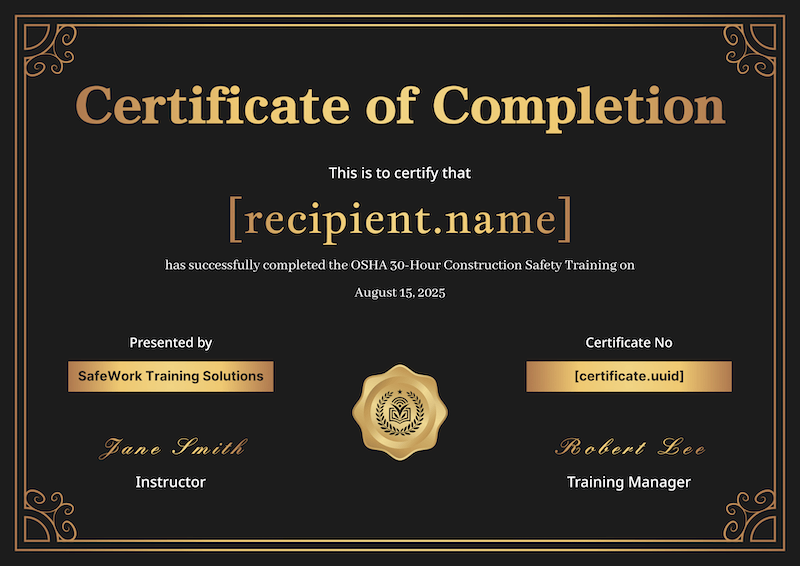
Example wording for training completion certificates
Ready-to-use wording you can adapt:
🧑💼 Corporate training
──────────────────────────────────────────────────────────────────────────────────────────────────
This Training Completion Certificate is presented to [Name]
for successfully completing the [Program Name] on [Date], demonstrating commitment to professional growth and excellence.
🏗️ Technical / compliance training
This certifies that [Name] has completed the [Safety / Technical Program Name]
in accordance with industry training standards on [Date].
💬 Soft skills workshop
Awarded to [Name] in recognition of participation and completion of the [Workshop Title],
held on [Date].
🩺 CPD / CME / CEU credit-bearing training
This is to certify that [Name] has completed [Program Name]
on [Date], earning [X] CPD hours toward continuing professional development.
For more wording variants, see our guide to certificate of completion wording
examples.
Design tips for training completion certificates
To make your certificate look professional and credible:
- Use simple, corporate-style fonts (Lato, Times, Playfair, Montserrat)
- Include your company or training provider logo
- Add a signature or seal for authenticity
- Keep the layout horizontal (landscape) for a formal appearance
- Use A4 or US Letter for easy printing and filing
- Add a QR code linking to the verification page — modern, audit-friendly, and unfakeable
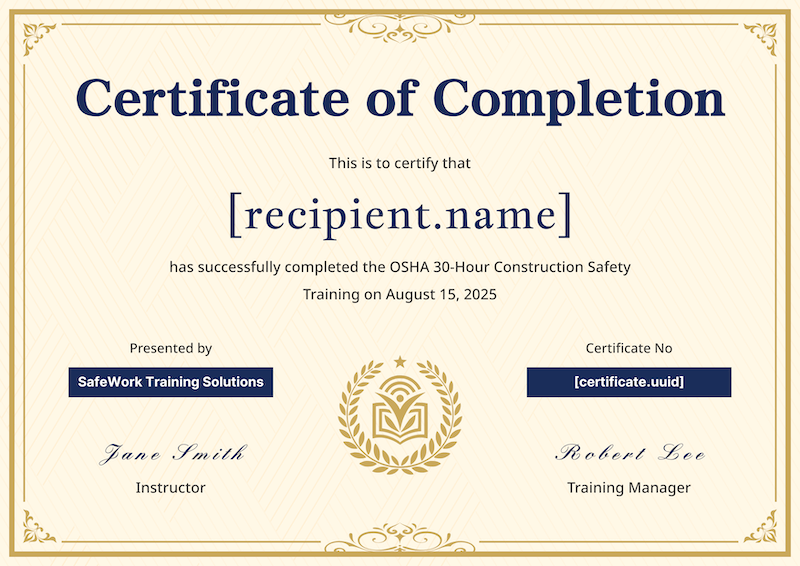
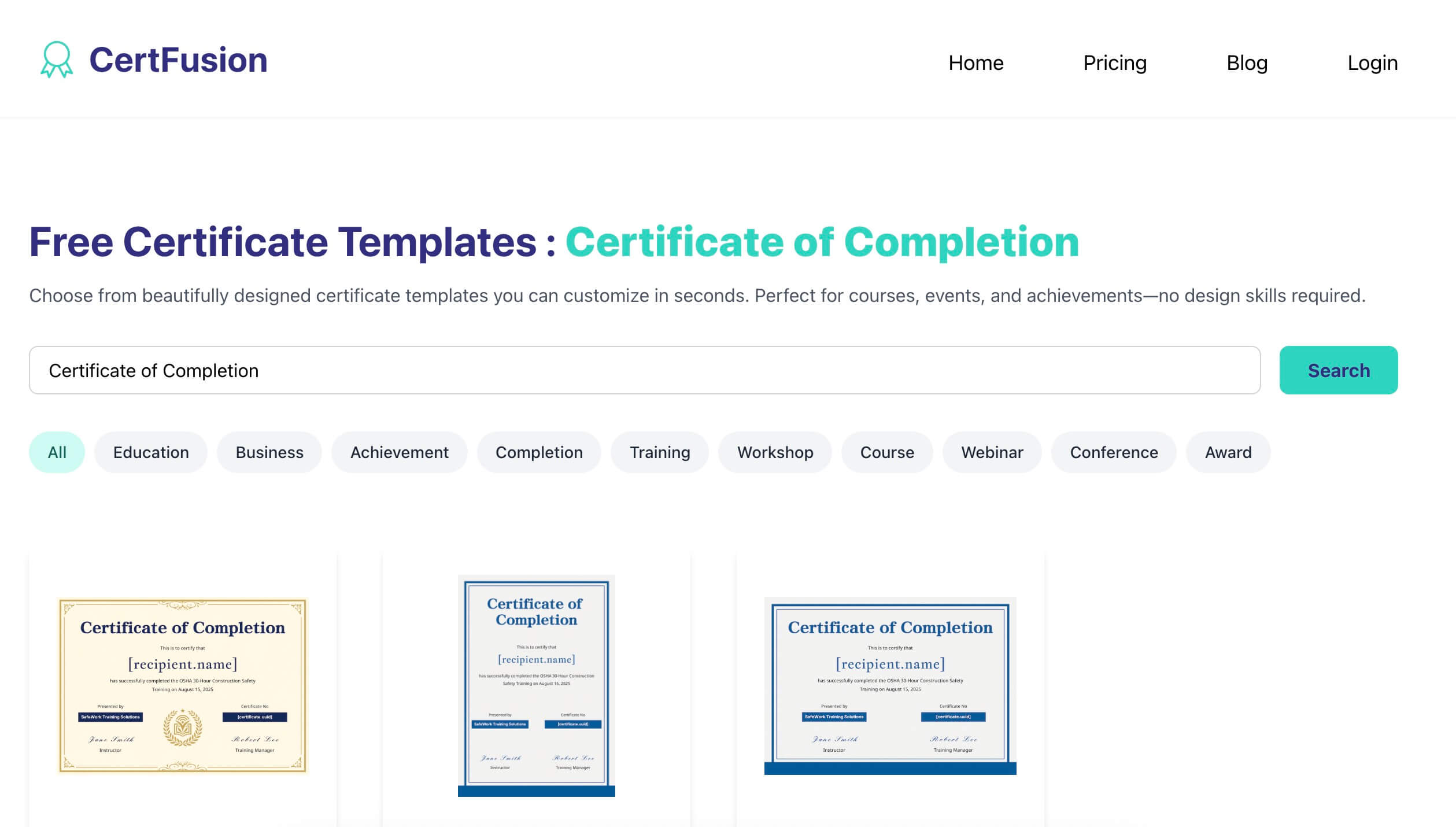
12 free training completion certificate templates
All templates are editable, printable, and free to use. Click any template to open it in the
editor — no signup required.
- Professional Corporate Training — Clean blue design with space for logo and trainer
signature - Modern Minimalist Training — Streamlined layout for HR and onboarding programs
- Safety & Compliance Training — Formal black-and-white design with organisation header
- Team Development Certificate — Friendly, motivational design for soft skills programs
- OSHA Training Completion — Compliance-ready template with credit hours field — see [OSHA training certificate template](https://certfusion.com/certificate-template/osha-training-certifica te-of-completion-template)
- First Aid Training — Medical-style template, see [classic first aid training certificate](h ttps://certfusion.com/certificate-template/classic-first-aid-training-certificate-template)
- Fire Safety Training — Badge-style design, see [fire safety training certificate](https://c ertfusion.com/certificate-template/fire-safety-training-certificate-with-badge-design)
- CPR / Life-Saving Skills — see [CPR life-saving skills certificate](https://certfusion.com/ certificate-template/cpr-life-saving-skills-certificate-with-heart-logo)
- Construction Safety Training — see [construction safety training certificate](https://certf usion.com/certificate-template/construction-safety-training-certificate-template)
- Executive Leadership Training — see [executive leadership training certificate](https://ce rtfusion.com/certificate-template/executive-leadership-training-certificate-template)
- Gold Border Completion — Premium look for high-stakes programs, see [gold border certificate of completion](https://certfusion.com/certificate-template/gold-border-certificate-of- completion-template)
- Modern Navy Panel Training — see [modern navy panel training certificate](https://certfusi on.com/certificate-template/modern-navy-panel-training-certificate-with-emblem)
👉 Browse all training certificate templates →
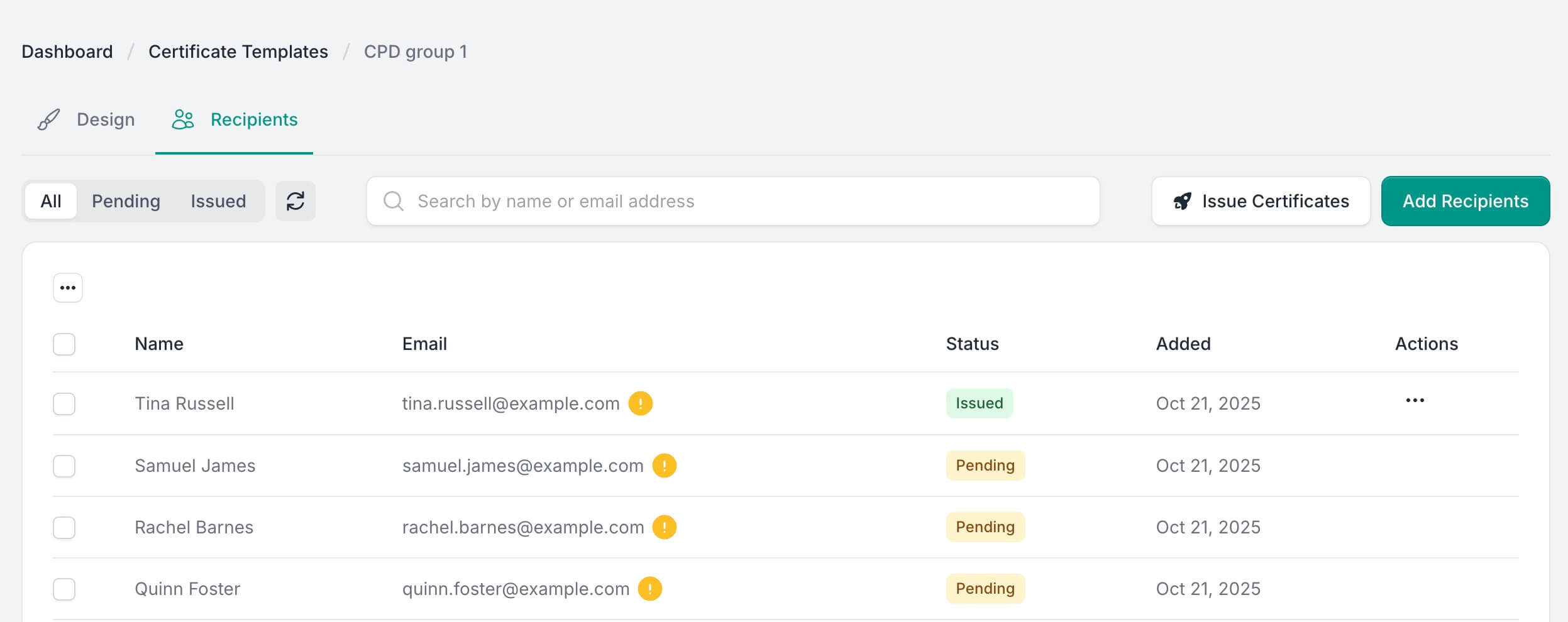
How to issue training completion certificates in bulk
If you run recurring training sessions, manually creating and sending certificates can take hours. Here's the fastest workflow:
- Pick a template from the gallery above
- Upload your attendee list as a CSV (or pull directly from Zoom, Google Meet, or Webex if it was a live session)
- Click "Issue all" — every attendee gets a branded, verifiable certificate emailed to them automatically
- Track opens, downloads, and shares from a single dashboard
CertFusion handles all four steps in under a minute — perfect for HR teams, online course platforms, and training providers issuing certificates at scale.
Training completion certificate vs certificate of achievement vs participation
These three are often confused. Quick guide:
| Type | When to use |
|---|---|
| Training completion certificate | The trainee finished the full program. Most common for |
| L&D, compliance, and skill-building courses. | |
| Certificate of achievement | The trainee not only finished but met or exceeded a performance |
| benchmark (test score, project, assessment). | |
| Certificate of participation | The trainee attended but no completion criteria were |
| assessed. Common for webinars and one-off workshops. |
If you're running a structured training program with a clear endpoint, completion is almost
always the right word.
Frequently asked questions
How do I write a certificate of completion?
Use respectful, acknowledging language — for example, "This certificate is awarded to [Name] for
successfully completing [Program Name] on [Date]." Always include the recipient's full name, the
program or course title, the completion date, the issuing organisation, and a signature or unique
verification ID. For accredited training, also include credit hours and a verification URL. See
our full certificate of completion wording
examples guide
for more.
What are the three types of certification?
The three main types are:
- Corporate (internal) certification — issued by an employer to confirm in-house training,
onboarding, or skill-building (e.g. a training completion certificate from an L&D team). - Product certification — issued by a vendor confirming proficiency in a specific tool or
platform (e.g. AWS Certified, HubSpot Certified). - Professional certification — issued by an independent body confirming mastery of a profession or trade (e.g. PMP, CPA, CPD/CME credit).
A training completion certificate usually falls into the corporate (internal) category.
Is a certificate of completion worth it?
Yes — for the recipient it's proof of effort and skill, useful on CVs and LinkedIn profiles. For
the issuer it's a record of compliance, an audit-ready document, and a low-cost way to motivate
participants. For accredited or regulated training (OSHA, first aid, CPD, CME) it's often legally
or contractually required.
Can anyone give a certificate of completion?
Yes. You don't need to be accredited to issue a certificate of completion — if a participant finishes your course, workshop, or training, you can issue one on your own terms. Accreditation is only required when the certificate carries formal credit (CPD, CME, CEU) or satisfies a regulatory requirement (OSHA, healthcare licensing).
What is a training completion certificate?
A training completion certificate is an official document confirming that a participant has
finished a training program. It includes the trainee's name, program name, completion date,
issuing organisation, and a unique verification ID — and for accredited programs, credit hours and
a tamper-proof verification URL.
Can I issue 100 training certificates at once?
Yes — upload your attendee list as a CSV and use bulk issue. CertFusion sends all 100 in a single click, each with its own verifiable link.
How do trainees verify their certificate?
Every CertFusion certificate includes a unique verification URL. Anyone — auditor, employer,
regulator — can visit the link to confirm the certificate is genuine, when it was issued, and to
whom.
Final thoughts
A training completion certificate is both a symbol of achievement and a practical record of
learning. With the right wording, design, and verification flow, it enhances professionalism and
protects you in audits.
Skip the manual work: use our free certificate of completion generator to pick a template, edit names and course details in your browser, and download a PDF or PNG in seconds — no signup required.
Table of Contents
Related Articles
Discover more insights and stories that might interest you